Airfy Talk
Your team's ideas, turned into work.
Airfy Talk lets your people speak ideas, notes, and tasks out loud and turns them into structured tickets, specs, and prompts. It runs on infrastructure you own, and it shows leadership exactly how much your team is getting done with AI.
Already running inside the company that builds Airfy.
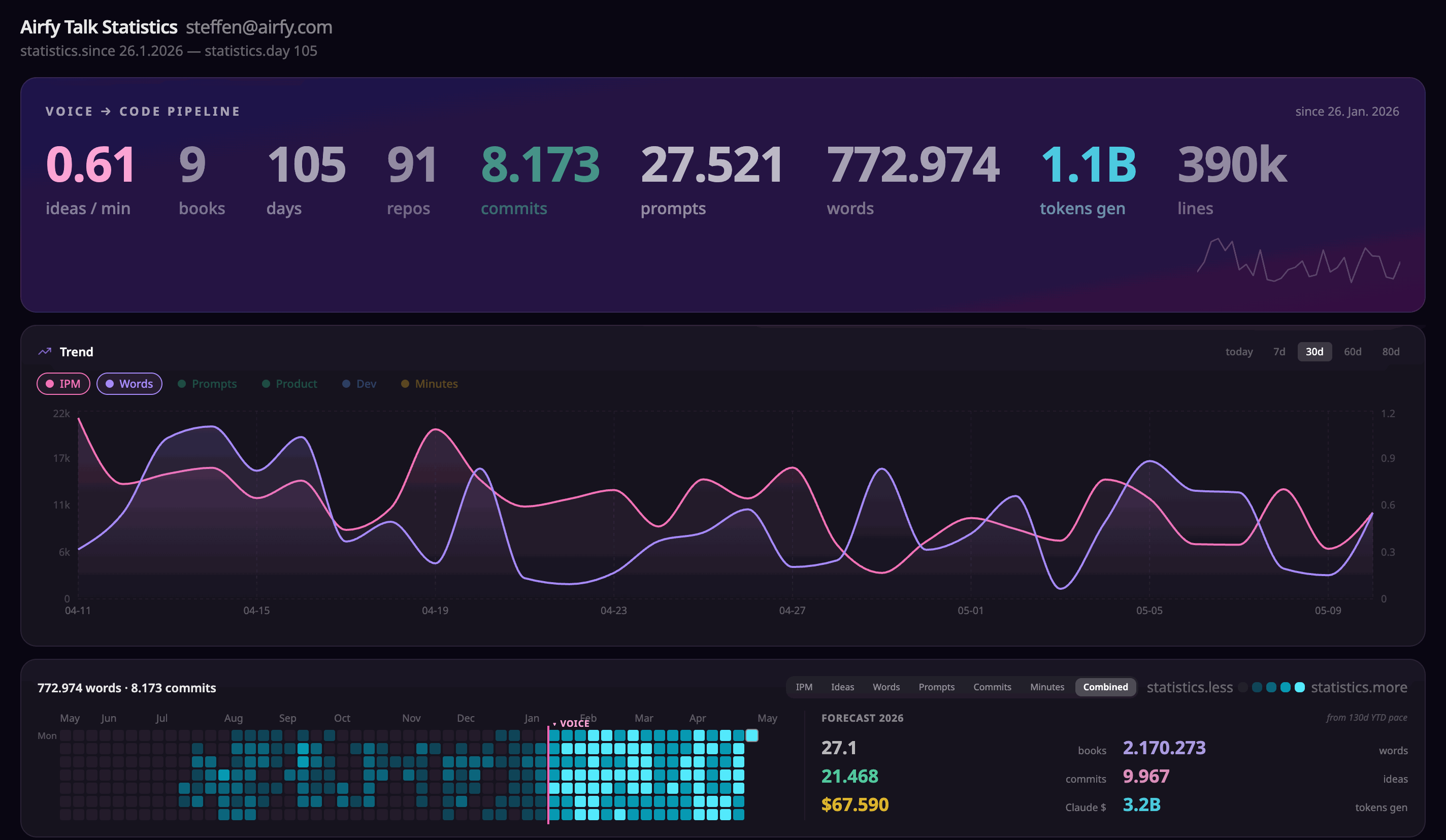
Three things change the day you switch it on.
Airfy Talk is not another place to log work. It removes the friction between a spoken idea and a unit of work the team can act on.
Ideas become tickets in seconds
Your people speak a thought out loud. It comes back as a structured ticket, spec, or prompt that the rest of the team can pick up and run with.
Leadership can see AI adoption, not guess it
A clear dashboard shows how much of the team is actually working with AI, how that trends over time, and where the real throughput is coming from.
Audio stays on hardware you own
Voice is sensitive. With Airfy Talk the recording is processed on a machine inside your own network and never leaves a system you control.
Speech in, structured work out.
Voice is just the input. The value is the closed loop: a spoken thought becomes reusable work that never leaves infrastructure you own.
Speak
Someone on the team talks through an idea, a customer note, a requirement, or a task. No form to fill in, no dashboard to open first.
Transcribe on your own machine
The audio is transcribed by a local speech model running on the GPUs inside the network Airfy manages for you. Nothing is shipped to an outside service.
Turn speech into structured work
The transcript becomes a clean ticket, spec, or prompt: a unit of work the team can act on, reuse, and connect to the rest of the product.
Show leadership the throughput
Every contribution rolls up into one dashboard, so leadership sees how much real work the team is producing with AI instead of guessing.
For the skeptics: transcription runs on a local speech model on a GPU node inside your network. No outside transcription service touches the audio. The proof lives here, not in the headline.
See the work, not just the headcount.
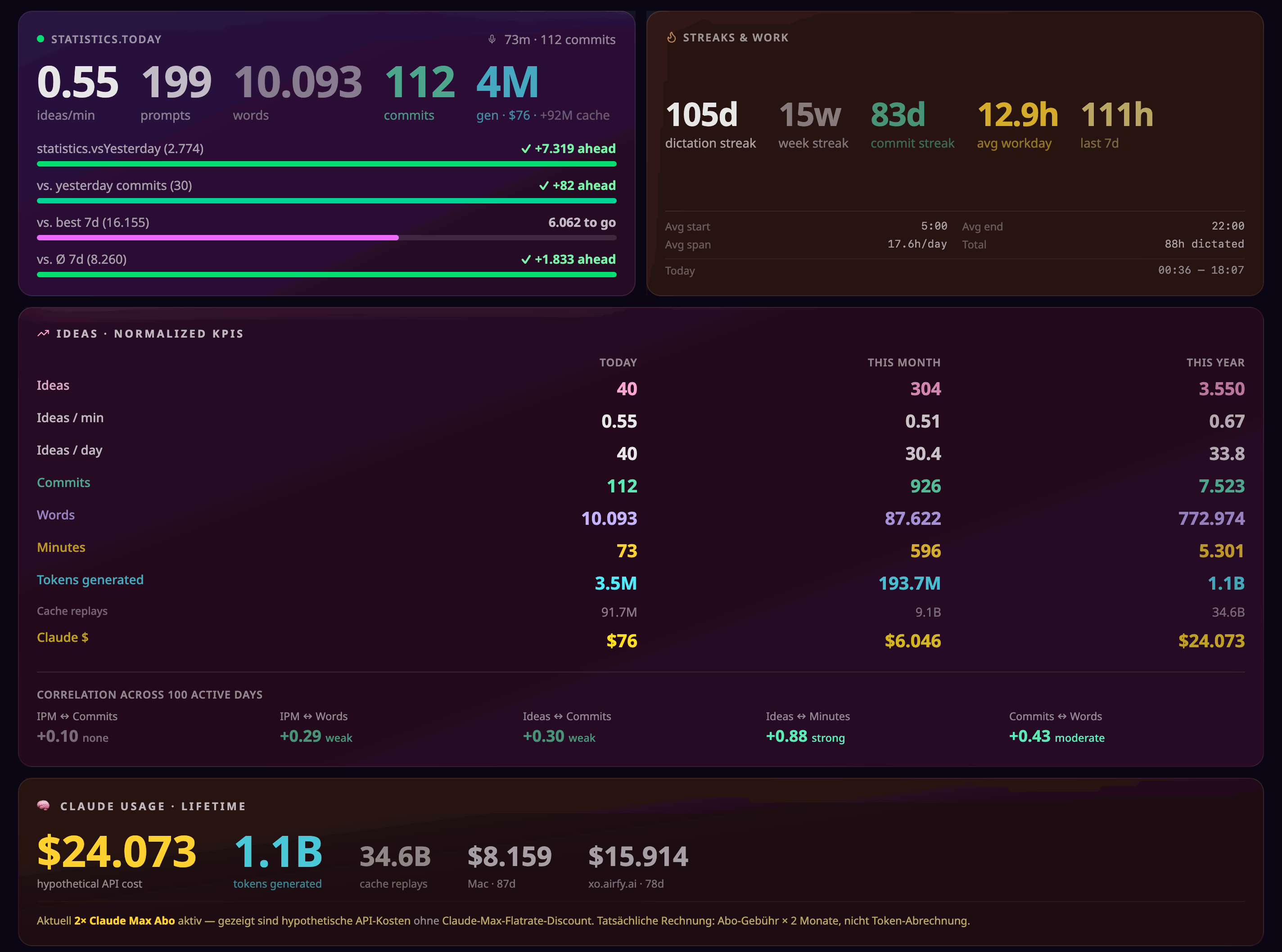
Airfy Talk gives leadership positive visibility: how much the team is producing with AI and where adoption is growing. It is built to show throughput, not to watch people.
Voice throughput
How many ideas, notes, and tasks the team is turning into structured work, day by day.
AI adoption
Who is actually working with AI, and how that adoption trends across the whole team over time.
Engineering flow
Where the work is moving smoothly and where it is getting stuck, visible without a status meeting.
Delivery
AI work tied back to real product delivery, so effort and outcome sit on the same screen.
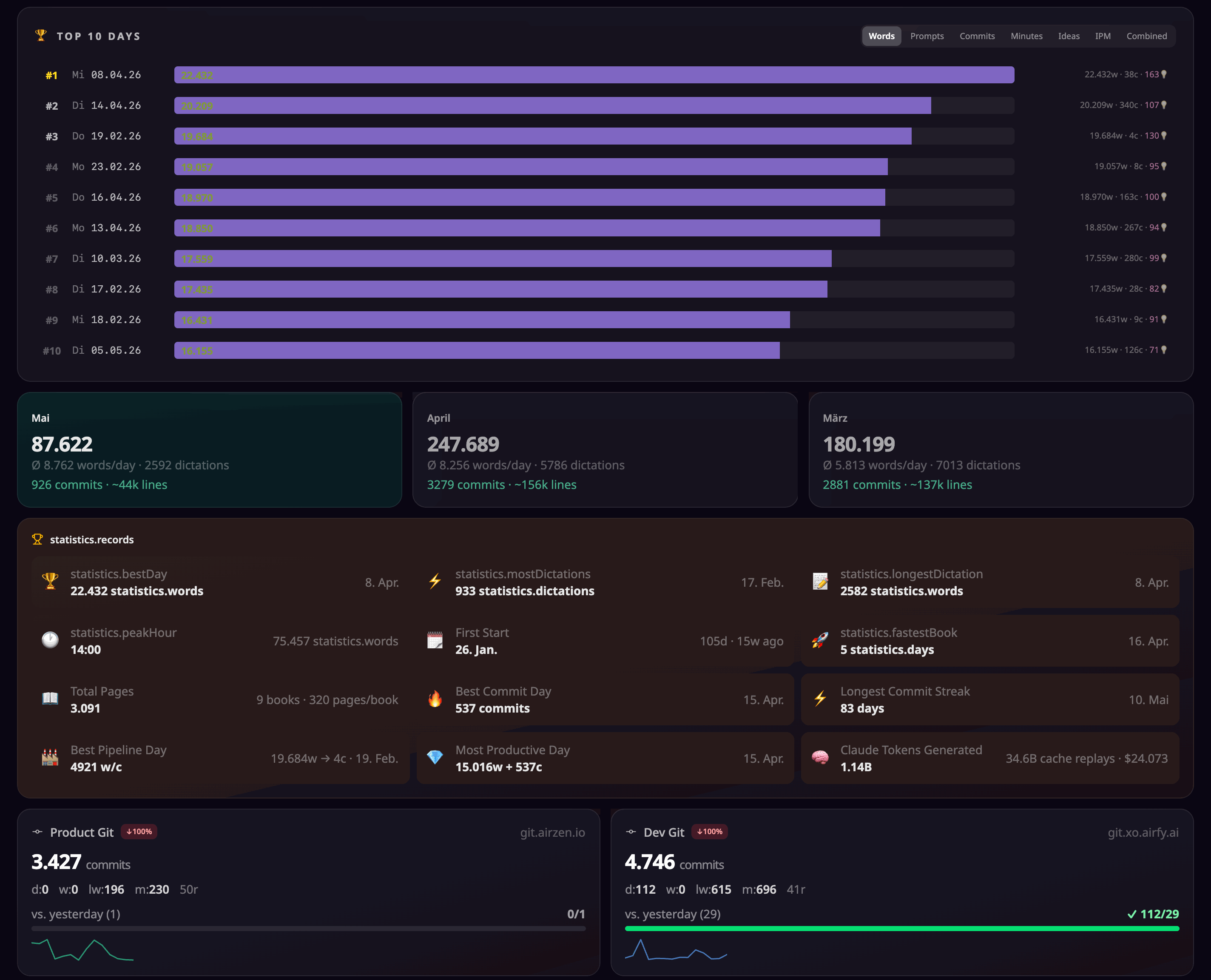
Connected to what actually ships.
A spoken idea is only worth something once it ships. Airfy Talk ties the work it captures back to real product delivery, so AI effort sits next to outcomes instead of floating beside them.
Leadership sees the strongest days and the records, and the team sees that the work they spoke into the system turned into something real.
Built for the company that owns its stack.
Airfy Talk runs on the GPUs inside the network Airfy manages for you. The same platform that runs your network runs the app on top of it. That is what it means to own your stack: the network, the compute, and the application.
Airfy is the operating system for your home and business. Airfy Talk is the proof that the operating system reaches all the way up to the app your team works in every day.
Private because of where it runs.
Voice carries the most sensitive things in a business: customer information, prices, and unfinished thoughts. Airfy Talk keeps that data on a node the customer owns. Privacy is not a setting bolted on later, it is where the product runs.
- The recording is processed on a node inside your own network. The audio never leaves a machine you own.
- Roles decide who can see what. Leadership sees throughput, not raw recordings of every person.
- Retention is configurable. Keep transcripts as long as you need, no longer.
- Every access is logged. You can audit who looked at what, and when.
Questions teams ask first.
Does the audio leave our building?
No. Airfy Talk transcribes speech on a node inside the network Airfy already manages for you. The recording is processed on hardware you own and is never shipped to an outside service.
What hardware does it need?
A GPU node inside your managed network. Because Airfy already runs the network, adding the compute that Airfy Talk needs is part of the same setup, not a separate project.
Is this surveillance?
No. Airfy Talk is built for positive visibility. Leadership sees how much real work the team is producing with AI and where adoption is growing. Roles, retention, and audit logging are all configurable so the team sees throughput, not a recording of every person.
Can it work with the tools we already use?
Yes. Airfy Talk produces structured tickets, specs, and prompts, so the output drops into the systems your team already works in instead of forcing a new one.
How does it connect to the rest of Airfy?
Airfy Talk runs on the GPUs inside the network Airfy manages. The same platform that runs your network runs the app on top of it. That is what it means to own your stack: the network, the compute, and the application.
See Airfy Talk running on your own infrastructure.
We will walk you through the dashboard, show you how speech becomes structured work, and explain how it runs on the GPUs inside the network we already manage for you.